Contents
Two people decide to move the same $80,000 IRA to a new provider.
The first signs a form, waits about a week, and logs in to find every holding sitting in the new account. The second gets a check in the mail, leaves it on the kitchen counter for three weeks, and then starts counting days on a calendar.
Same money. Same destination. Very different amounts of stress.
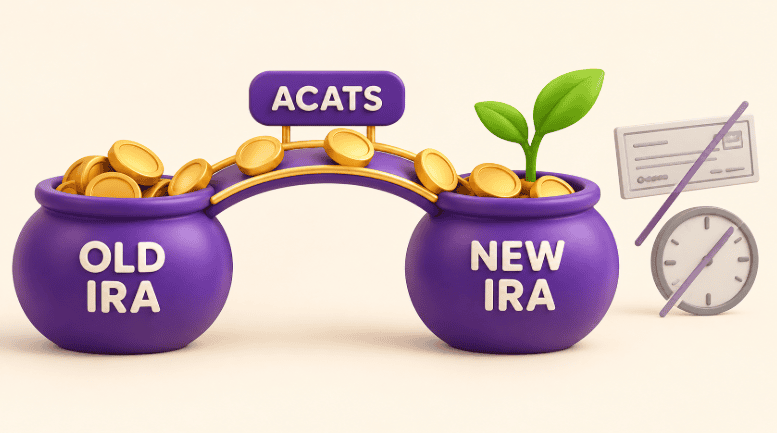
The first person used an ACATS transfer. It is the least dramatic way to move a retirement account, and when your money is already in an IRA, it's usually the one to use.
If your money is still in an old employer 401(k), that's a different route. Start with [How the 60-Day Rollover Works When You Move a 401(k) Into a SIMPLE IRA] and come back here for any IRA money.
- An ACATS transfer moves an IRA from one firm to another, usually in kind, so nothing is sold and nothing is taxed.
- Because the money never passes through your hands, there is no withholding, no 60-day deadline, and no once-per-12-months limit.
- ACATS is for IRA-to-IRA moves between firms. Old 401(k) money usually moves by direct rollover instead.
- You start the transfer at the new firm. Don't close the old account yourself.
- SIMPLE IRAs have a twist: SIMPLE-to-SIMPLE transfers can happen anytime, but other IRA and 401(k) money can only come in after the 2-year mark.
What ACATS actually means
ACATS stands for Automated Customer Account Transfer Service. It is the system U.S. brokerage firms use to move an account from one firm to another. You never log in to it. Your new firm submits the request, your old firm confirms the account details, and the holdings move across electronically.
Two details matter. First, it usually moves your holdings in kind, meaning your investments arrive as the same investments instead of being sold for cash first. Second, a transfer is not a distribution. As far as the IRS is concerned, the money never left a retirement account. There is nothing to withhold, nothing to redeposit within 60 days, and no rollover to report.
Transfer vs. rollover: the difference
People use these words as if they mean the same thing. They don't, and the difference shows up in your deadlines, your withholding, and your tax return.
| ACATS / direct transfer | Direct rollover | 60-day rollover | |
|---|---|---|---|
| Money comes from | An IRA at another firm | An old 401(k) or other employer plan | A 401(k) or an IRA |
| Who receives the money | Your new firm, directly | Your new firm, usually by check payable to it | You |
| Withholding | None | None | 20% from a 401(k), 10% default from an IRA |
| Deadline | None | None | 60 days |
| Once-a-year limit | No | No | Yes, for IRA-to-IRA |
| What gets reported | Nothing as a rollover | Form 1099-R and Form 5498 | Form 1099-R and Form 5498 |
The pattern is simple. The less the money touches you, the fewer ways there are to trip over a rule.
Which one do you need?
Start with where the money sits today.
| Where your money is now | Best route |
|---|---|
| An old employer 401(k) | Direct rollover. ACATS usually doesn't apply, because the plan's recordkeeper sends a check or wire. |
| A Traditional or Roth IRA at another firm | ACATS transfer, into the same type of account |
| A SIMPLE IRA at another provider | ACATS transfer, SIMPLE to SIMPLE, any time |
| A check already made out to you | 60-day rollover. The clock is already running, so read [our 60-day guide] today. |
How an ACATS transfer works, step by step
- Open the new account first. It needs to match the old one: Traditional to Traditional, Roth to Roth, SIMPLE to SIMPLE. The name and Social Security number must match too.
- Grab your latest statement from the old firm. You need the account number and the account title exactly as printed.
- Start the transfer at the new firm. Choose a full or partial transfer, and in kind or cash.
- Let the old firm validate it. They confirm the details and flag anything that can't move. If something doesn't match, expect a call or an email.
- Watch the assets arrive. Most transfers finish in about a week. Holdings sometimes land in pieces over a few days.
- Check the new account. Confirm every holding arrived, name your beneficiaries, and set your investments. A fully transferred account usually closes on its own.
What moves, and what doesn't
Most stocks, ETFs, and many mutual funds move in kind. Some things don't: funds that only the old firm offers (often called proprietary funds), CDs, annuities, and certain partnership interests. These either get sold for cash before the transfer or stay behind.
Selling inside an IRA doesn't create a tax bill, but it can leave you in cash for a few days. Look at your holdings before you start, not after.
Also ask the old firm about an outgoing transfer fee. Many charge a flat one, and it's worth asking your new provider whether they cover it.
The SIMPLE IRA twist
SIMPLE IRAs play by their own rules, and this is where people get tripped up.
If you're moving an existing SIMPLE IRA from another provider, the transfer can happen at any time, and it doesn't restart your 2-year clock. That clock runs from the day you first took part in a SIMPLE plan, not from the day you open the new account.
If you're bringing a Traditional IRA or an old 401(k) into a SIMPLE IRA, the 2-year rule from our rollover guide still applies. During the first 2 years, a SIMPLE IRA can only take money from another SIMPLE IRA. Moving money in the wrong direction inside that window can turn into a taxable withdrawal with an extra 25% tax on top.
Four mistakes that slow a transfer down
- Closing the old account first. The new firm pulls the assets. If you close first, you can end up with a check in your name and a clock you didn't want.
- Mismatched names or account types. "Jon Smith" at one firm and "Jonathan Smith" at the other is enough to get a request rejected. So is trying to move a Traditional IRA into a Roth. That's a conversion, and it's taxable.
- Forgetting your required minimum distribution. If you owe an RMD this year, take it from the old account first. RMDs can't be transferred or rolled over.
- Assuming beneficiaries follow you. They don't. Name them again at the new firm.
Before you start
- Confirm the old and new accounts are the same type.
- Get a recent statement and copy the account title exactly.
- Check your holdings for anything proprietary or non-transferable.
- Ask the old firm about outgoing transfer fees.
- If you're over RMD age, take this year's distribution first.
Not sure which route fits your money? Tell us where it is today and we'll tell you where to start.
This article is for general education and is not tax or legal advice. Retirement account rules are detailed and change over time, and every situation is different. Please talk with a qualified tax professional about your specific circumstances before moving retirement funds
FAQs
- IRS: Rollovers of Retirement Plan and IRA Distributions
- IRS: IRA One-Rollover-Per-Year Rule
- IRS: SIMPLE IRA Withdrawal and Transfer Rules
- IRS: SIMPLE IRA Withdrawal and Transfer Rules
- IRS: Publication 590-A, Contributions to Individual Retirement Arrangements (IRAs)
- FINRA Rule 11870: Customer Account Transfer Contracts
About the Author

Not sure which plan fits?
Answer three quick questions about team size and budget - we'll match you to a plan, no reading required.